Published on 13/10/2025 by James Best
Hunting for Black Holes: How Andrea Ghez Found Monsters in Space!
The Mystery at the Heart of Our Galaxy!
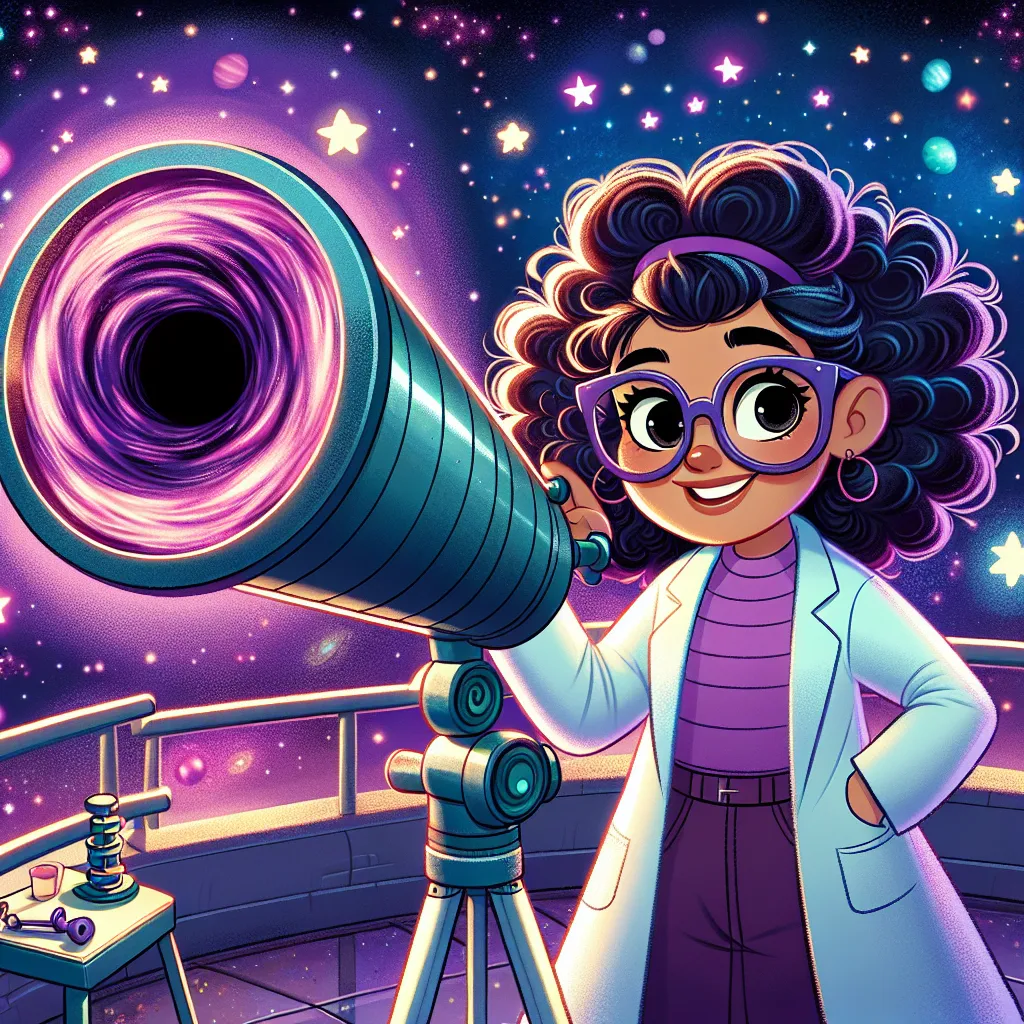
Have you ever wondered what’s at the centre of our Milky Way galaxy? For years, scientists suspected something massive and mysterious was hiding there, but nobody could see it. It’s like having a powerful vacuum cleaner under your bed that you can’t see—you only know it’s there because your socks keep disappearing! 🔭
That’s exactly the puzzle that astronomer Andrea Ghez decided to solve. While other children were reading bedtime stories, young Andrea was gazing at the stars and asking questions about our universe. Years later, she would make one of the biggest discoveries in astronomy—proving that a supermassive black hole lives at the centre of our galaxy!
This invisible space monster is so powerful it can swallow entire stars, yet Professor Ghez found ways to “see” something that gives off no light at all. How did she do it? Let’s explore the amazing detective work of this cosmic detective!
The Big Idea: Black Holes and Invisible Giants
Imagine you’re playing catch with a friend in the park. You throw the ball, and it travels in a straight line. But what if there was something incredibly heavy in the middle of the park—so heavy that it bent the path of your ball, making it curve around in circles? That’s similar to what happens near a black hole!
Black holes are regions in space where gravity is so strong that nothing, not even light, can escape once it gets too close. They’re like cosmic whirlpools, spinning and pulling everything nearby towards them. The largest ones are called “supermassive black holes” and can be millions or billions of times heavier than our Sun!
Here are some fascinating facts about black holes:
- A black hole the size of a penny would weigh as much as Mount Everest
- Time moves more slowly near a black hole (just like in the film “Interstellar”!)
- Black holes aren’t really “holes”—they’re incredibly dense objects
- They can stretch you out like spaghetti if you fall into one (scientists call this “spaghettification”!)
- Some black holes shoot powerful jets of energy thousands of light-years into space
Did You Know?
- If our Sun suddenly became a black hole (don’t worry, it won’t!), Earth wouldn’t get sucked in. We’d keep orbiting as normal, but we’d be very cold without sunlight!
- The first photo of a black hole was only taken in 2019, long after Andrea Ghez began her research.
- Some scientists think tiny black holes might have formed right after the Big Bang.
Science Spotlight: Andrea Ghez, The Black Hole Hunter
Andrea Ghez didn’t set out to find black holes when she was a child. Born in New York City in 1965, she became fascinated with space after watching the Moon landings. She studied physics at MIT and then earned her doctorate at Caltech, where she began using powerful telescopes to study the stars.
In the 1990s, Ghez began a project that would change our understanding of the universe. She wanted to see what was happening at the very centre of our Milky Way galaxy—a place called Sagittarius A* (pronounced “Sagittarius A-star”). The problem? This region is 26,000 light-years away and hidden behind thick clouds of dust.
To solve this problem, Ghez used special infrared cameras that can see through dust clouds and the world’s largest telescopes in Hawaii. She carefully tracked the movements of stars near the galactic centre over many years. By watching how these stars moved—some whipping around at incredible speeds in strange orbits—she proved they must be circling around something incredibly massive yet invisible: a supermassive black hole!
For this groundbreaking work, Andrea Ghez was awarded the Nobel Prize in Physics in 2020, becoming only the fourth woman ever to win this prize. Her discovery helps scientists understand how galaxies form and evolve. Today, her work continues to inspire space missions and telescope designs that help us understand these cosmic monsters.
Hands-On Discovery: Create Your Own Black Hole Gravity Well!
Want to see how black holes bend space? Let’s create a model that shows how gravity works!
Safety Warning: This activity requires adult supervision when using scissors.
Materials Needed:
- Large round balloon
- Old stretchy t-shirt or piece of lycra/spandex fabric
- Scissors
- Large embroidery hoop or plastic hula hoop
- Small marbles or metal ball bearings
- Several coins of different sizes
- Tennis ball
Instructions:
- Cut a large circle from the t-shirt or fabric (ask an adult to help with cutting)
- Stretch the fabric tightly over the hoop and secure it
- Place your “gravity well” on a flat surface with space around all sides
- Place a heavy ball (like a tennis ball) in the middle of the fabric to create a deep depression
- Now roll marbles across the fabric at different speeds and angles
What You Should See: The marbles will roll around the central ball in curved paths, sometimes making complete orbits before eventually spiraling inward. Lighter marbles will fall in more quickly than heavier ones.
Try This! Place coins of different sizes on the fabric and observe how they interact with each other. The heavier coins create deeper “gravity wells” that affect nearby objects.
The Science Behind It: This model demonstrates Einstein’s theory of general relativity, which tells us that massive objects like stars and black holes don’t just “pull” on other objects—they actually bend the fabric of space-time itself! In our model:
- The fabric represents space-time
- The tennis ball represents a black hole or star
- The marbles represent planets, stars or light beams passing nearby
In real space, black holes create such deep “dents” in space-time that once something crosses a certain boundary (called the event horizon), it cannot escape. Even light beams follow these curved paths, which is why black holes can bend light from stars behind them—an effect called “gravitational lensing” that astronomers use to detect black holes.
Fun Facts and Mind-Bogglers!
-
The supermassive black hole that Andrea Ghez discovered is 4.3 million times more massive than our Sun! If it replaced our Sun, it would fit inside Mercury’s orbit but would gobble up all the inner planets.
-
If you could somehow stand on this black hole’s event horizon (you can’t!), time would pass so differently that one hour for you would equal about 100 years for your friends back on Earth.
-
Black holes aren’t actually black! They sometimes give off a special kind of radiation called “Hawking radiation,” named after the famous scientist Stephen Hawking.
-
WOW STATISTIC: If Earth were shrunk down to the size of a black hole, it would be smaller than a marble—about the size of a pea! Yet it would still weigh the same as our entire planet.
Explorer’s Challenge
Ready to become a black hole explorer like Andrea Ghez? Try these activities:
-
Star Tracking: On a clear night, use a mobile phone app like SkyView or Star Walk to find bright stars. Take photos of the same section of sky over several nights. Can you see any stars that have moved? Real astronomers like Andrea Ghez track stars over many years!
-
Gravity Research: Find five round objects of different weights (like a ping-pong ball, an apple, a marble, etc.). Place them on a soft pillow. Which ones make the deepest impression? How does this relate to how massive objects bend space?
-
Think About This: If black holes pull
Written by James Best
← Back to blog