Published on 13/10/2025 by James Best
Knock, Knock, No Ouch! How Woodpeckers Bash Trees Without Getting Dizzy
A Head-Banging Mystery!
Have you ever hit your head on something by accident? Ouch! Even a small bump can really hurt and might give you a headache. Now imagine banging your head against a tree trunk as hard as you can… 20 times every second! 🤯 That’s exactly what woodpeckers do all day long. These remarkable birds hammer their beaks into tree trunks up to 12,000 times per day, with each impact about 1,000 times stronger than the force of gravity. That’s like riding a super fast rollercoaster that stops suddenly—over and over again!
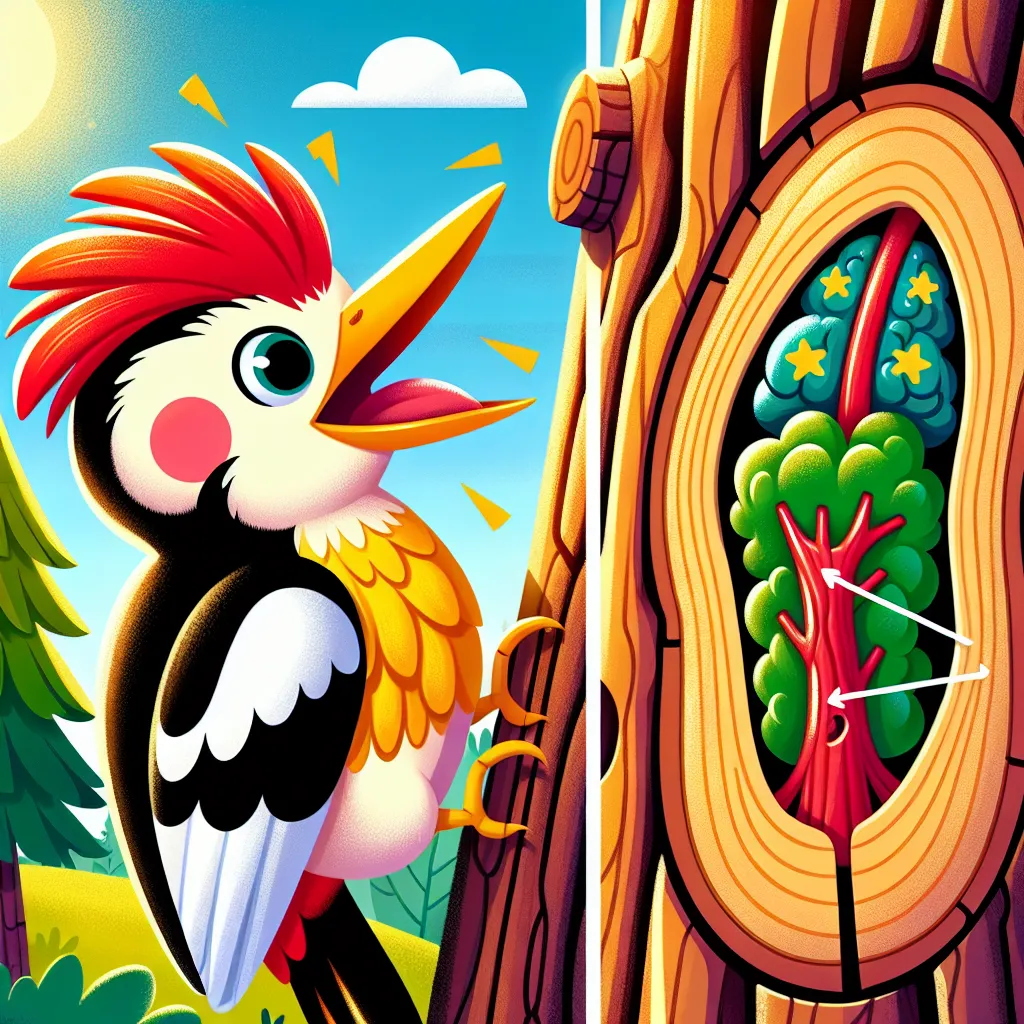
So why don’t woodpeckers get terrible headaches or brain damage? How can they bash their heads all day without getting dizzy or hurt? The answer is hidden inside their extraordinary heads, and scientists are now copying these clever bird designs to help protect people!
The Big Idea: Nature’s Perfect Helmet
Woodpeckers are nature’s professional headbangers, but they never need paracetamol! Their bodies have evolved some incredible adaptations that work together like a sophisticated shock absorption system.
Here are some fascinating facts about woodpecker superpowers:
- Their skulls have spongy, plate-like bone that spreads impact forces away from the brain
- A special hyoid bone wraps all the way around their skull like a seatbelt for their brain
- Their beaks have a special spongy layer between the tip and skull that absorbs shock
- Woodpeckers have incredibly strong neck muscles that control the impact
- Their brains are packed tightly in the skull with almost no room to move around and get damaged
- The woodpecker’s tongue is extremely long—it can extend to three times the length of its beak!
Did You Know? Woodpeckers close their eyes just before each impact! They have special third eyelids that snap shut milliseconds before their beaks hit the tree, protecting their eyes from flying splinters and the shock of impact.
When a woodpecker hammers a tree, it’s not just randomly bashing about. The bird’s head moves in a very straight line—almost like a drill or hammer—rather than wobbling side to side. This straight-line movement helps prevent rotational forces, which are the most damaging kind of forces for brains.
Think of it like this: if you shake a bottle of fizzy drink in a straight line up and down, not much happens. But if you shake it in circles, it gets all mixed up inside. The same is true for brains—straight-line forces are much safer than twisting ones!
Science Spotlight: Studying Woodpeckers to Protect People In 2018, Professor Lakiesha Williams and her team at Mississippi State University studied woodpecker skulls using high-speed video and computer models. They discovered that the woodpecker’s unique skull structure could inspire better protective helmets for sports and military use. Today, several companies are creating “woodpecker-inspired” helmets that can reduce concussions in sports like rugby, American football, and cycling. During the COVID-19 pandemic, some researchers even applied woodpecker design principles to create better protective gear for healthcare workers. Professor Williams’ work shows how studying animals can lead to surprising innovations that protect human health!
Hands-On Discovery: Build a Woodpecker Shock Absorber
Let’s test how shock absorption works!
In this experiment, we’ll see how different materials can protect an egg (our “brain”) from impact—just like a woodpecker’s special adaptations protect its brain.
Safety Warning: This experiment involves raw eggs. Adult supervision is required. Be careful handling raw eggs and wash your hands thoroughly afterwards.
Materials:
- 3-4 raw eggs
- Different protective materials (bubble wrap, kitchen roll, cotton wool, sponges)
- Clear plastic bags or cling film
- Scissors
- Tape
- A drop cloth or newspaper (this might get messy!)
- A hard floor or pavement
Instructions:
- Wrap each egg in cling film or place it in a small plastic bag (this contains any mess if it breaks)
- Create different “helmets” for your eggs using the various materials:
- One with just a thin layer of kitchen roll
- One with thick bubble wrap
- One with layers of different materials (sponge, cotton wool, etc.)
- Leave one egg unwrapped as your control
- Drop each egg from the same height (start low, about 30cm)
- Observe which eggs survive and which crack
- For eggs that survive, increase the drop height and try again
The Science Behind It: When an egg hits the ground, the sudden stop creates a force that can crack the shell. This is similar to what happens when your brain experiences impact. The woodpecker’s special adaptations work like your protective materials—they absorb and distribute the force of impact, preventing damage.
The best protective designs will:
- Absorb energy (like the spongy bone in a woodpecker’s skull)
- Spread the force across a larger area (like the woodpecker’s hyoid bone)
- Slow down the impact (like the woodpecker’s strong neck muscles)
Which of your designs worked best? How does this compare to a woodpecker’s built-in protection?
Mind-Blowing Woodpecker Facts!
-
A woodpecker’s tongue can be up to 4 times longer than its beak! It wraps around the back of its skull when not in use.
-
During each peck, a woodpecker’s head experiences deceleration forces of about 1,200g. Humans lose consciousness at just 4-6g!
-
Woodpeckers don’t just drum trees to find food—they also do it to communicate with other woodpeckers and mark their territory. It’s like sending a message by Morse code!
-
Wow Statistic: If humans could withstand impacts like woodpeckers, we could crash into a brick wall at 25 kilometres per hour—with our heads—and walk away without injury!
-
The Great Spotted Woodpecker, common in British woodlands, can peck up to 20 times per second. That’s faster than you can say “woodpecker” twice!
Explorer’s Challenge
Ready to become a woodpecker expert? Try these activities:
-
Woodpecker Watch: Visit a local woodland with an adult and listen for drumming sounds. Different woodpecker species have different drumming patterns. Can you spot the difference between a Great Spotted Woodpecker’s short, fast drumroll and a Green Woodpecker’s slower tapping?
-
Design Challenge: Can you design a better bicycle helmet based on woodpecker adaptations? Draw your design and explain how it works.
-
Sound Detective: Tap different materials around your home with a pencil (with permission!). Which materials make the loudest sound? Which ones dampen the sound? How might this relate to what woodpeckers listen for when finding insects?
-
Think About: How might engineers use woodpecker designs to make safer cars? What about protecting mobile phones from breaking when dropped?
The Big Question
Woodpeckers show us that sometimes the most amazing solutions to problems can be found by watching nature. Their incredible heads have evolved over millions of years to solve a difficult problem—how to hammer into wood without getting hurt.
Next time you see or hear a woodpecker, remember the extraordinary engineering inside its head. And think about this: what other solutions might nature have already figured out that we haven’t discovered yet? Perhaps you’ll be the scientist who finds the next big idea by observing the amazing animals around us!
What animal would you study to solve a human problem? What might you learn from watching it
Written by James Best
← Back to blog